Wednesday, April 15, 2009

Poetry Week Day Three: Julia Alvarez

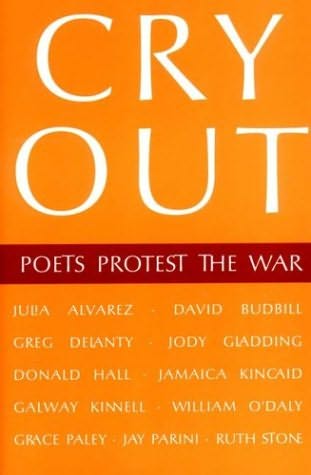
We're getting a little political with today's poem. It comes from the collection Cry Out: Poets Protest the War, which gathers the poems read by eleven contemporary poets in Manchester, Vermont in 2003 in response to the recent cancellation of a White House poetry symposium. Julia Alvarez contributed this poem, among others, to the reading and the collection. She prefaces the poem with this:

Many of you may know the poem by Auden in which the line occurs: "Poetry makes nothing happen," which he doesn't mean. so the title of this one is that Auden quote, "Poetry Makes Nothing Happen," but I add a question mark:

"Poetry Makes Nothing Happen"?
-
W. H. Auden

Listening to a poem on the radio,
Mike Holmquist stayed awake on his drive home
from Laramie on Interstate 80,
tapping his hand to the beat of some lines
by Longfellow; while overcome by grief
one lonesome night when the bathroom cabinet
still held her husband's meds, May Quinn reached out
for a book by Yeats instead and fell asleep
cradling "When You Are Old," not the poet's best,
but still... poetry made nothing happen,

which was good, given what May had in mind.
Writing a paper on a Bishop poem,
Jenny Klein missed her ride but arrived home
to the cancer news in a better frame of mind.
While troops dropped down into Afghanistan
in the living room, Naomi Stella clapped
to the nursery rhyme her father had turned on,
All the king's horses and all the king's men...
If only poetry had made nothing happen!
If only the president had listened to Auden!

Faith Chaney, Lulú Pérez, Sunghee Chen--
there's a list as long as an epic poem
of folks who'll swear a poem has never done
a thing for them...except... perhaps adjust
the sunset view one cloudy afternoon,
which made them see themselves or see the world
in a different light - degrees of change so small
only a poem registers them at all.
That's why they can be trusted, why poems might
still save us from what happens in the world.

for Jay Parini

Tuesday, April 14, 2009

Poetry Week Day Two: Daniel Hoffman

We continue our week of poetry on poetry with this great opening piece from Daniel Hoffman's collection of sonnets, Makes You Stop and Think:

The Sonnet
(Remembering Louise Bogan)

The Sonnet, she told the crowd of bearded
youths, their hands exploring
rumpled girls,
is a sacred

vessel: it takes a civilization
to conceive its shape or know
its uses. The kids
stared as though

a Sphinx now spake the riddle of
a blasted day. And few,
she said, who would
be avant-garde

consider that the term is drawn
from tactics in the Prussian
war, nor think
when once they've breached

the fortress of a form, then send
their shock-troops yet again
to breach the form,
there's no form--

--they asked for her opinion of
"the poetry of Rock."
After a drink
with the professors

she said, This is a bad time,
bad for poetry.
Then with maenad
gaze upon

the imaged ghost of a comelier day:
I've enjoyed this visit,
your wife's sheets
are Irish linen.


(NB: The poem is presented here sans formatting, since html is unfriendly to unconventional spacing.)

Monday, April 13, 2009

Celebrate National Poetry Month with George Braziller

We kicked off National Poetry Month with a beautiful excerpt from Charles Simic's new book, The Renegade. Now that we're almost halfway done (!) with April, it seems like a good time to look at how our poets experience poetry in their work. Every day this week we'll be posting a poem from one of our books that deals with the theme of poetry and writing.

We'll start with Simic again, from his Selected Early Poems:

Poem

My father writes all day, all night:
Writes while he sleeps, writes in his coffin.
It's nice and quiet in our house.
You can see the specks of dust in the sunlight.

I look at times over his shoulders
At all that whiteness. The snow if falling,
As you'd expect. A drop of ink
Gets buried easily, like a footprint.

I, too, would get lost but there's his shadow
On the wall, like a perched owl.
There's the sound of his pen
And the bottle on the table sunk in thought.

When the bottle empties
His great dark hand
Bigger than the earth
Feels for the moon's spigot.

Tuesday, April 7, 2009

Meet Will Barnet on ArtBabble

After reading the piece on ArtBabble in today's New York Times, we decided to check the website out. It's a great resource for artist interviews, retrospectives, and just building an online community around art and artists. And what a fancy design!

What's more, there's a video on Will Barnet, the prolific American artist, talking about his work and influences. We're publishing Will Barnet: A Sketchbook, 1932-1934 a collection of Barnet's never-before-seen early sketches, in May to celebrate his 98th birthday.

Check out the video here:

Thursday, April 2, 2009

Re-Presenting


The best part of producing art books is working with the art itself. We spend a lot of time with art pieces, making sure that our reproductions are faithful to the originals—we want you (our readers) to see something perfect, something that lets you know how it feels to see the art in person. Here's what we do:

Step One: Viewing the Work

After Braziller, Inc., decides to move forward with a new illustrated title, I arrange a viewing of the art. It is impossible to gather everyone involved—perhaps the art collector can't fly into New York, so s/he allows his/her irreplaceable property to travel by FedEx—but we do what we can. A standard viewing session can include a photographer and his assistants, Mr. Braziller, myself, a designer, a printing specialist, a museum director, and even (when absolutely necessary) an author, all of us wearing cotton gloves à la Mickey Mouse. The first five minutes after the art has been arranged on the table are the happiest of the production process.

Step Two: Understanding the Work

Immediately thereafter, the problems begin. Someone says that the art's textures and jagged edges must be perfectly reproduced or the effect will be ruined, but the photographer asserts that this is impossible. The art's owner says that the work needs to be returned quickly for a forthcoming exhibition, and though the designer agrees to work in this time frame, the author wants to keep the pieces on hand for reference. There are flecks of gold in the medium used, and I wonder if these can be reproduced somehow... I start sweating.

Step Three: Photography and Scanning

After the meeting, we leave the art in the hands of a photographer or scanner. They do the most absurd things to art, they really do, and I only vaguely understand them. I've seen a photographer hang sketches by slapping them onto a vaccuum-suction wall. I've seen art adhered to drum scanners, bent painfully in the process. In any case, it's really best that we don't know about this process.

Step Four: Proofs

After a photographer or scanner sends their digital files to the printer, the printer sends us a packet of proofs. Proofs usually arrive when we're right in the middle of something important, but all office work grinds to a halt, and everyone gathers round—are the proofs too red? too green? too dark or light? warm or cool? Is the paper so thin that the ink bleeds through? If the original art is on textured paper, shouldn't the book's paper be textured too? We run the back of our hands over the paper, flick the corners, compare its weight to the weight of other papers we've liked before. If we have the original art on hand, we stare back and forth between the proofs and the originals for over an hour. If we don't have the art, the proofs need to be mailed to someone who does... and hope that we hear from them soon.

Step Five: Proofs. Again.

Seriously though, this second set of proofs is better, but it's still a little red, don't you think? Oh, maybe it's just that the paper color is too cool.

Step Six: Proofs. Again.

Didn't we tell them to remove that smudge?

When the book goes to press, we still have a lot of worries. On a big run of books, the first thousand might come out too dark, and the last thousand might come out too light, but the middle 15,000 are just right. On a small run, the first are too light, the last too dark, and there are no perfect copies in between. The next time you pick up an art book, have a look and ask yourself: is this 140 gsm paper? does it have too much tooth? should it have been printed 6c instead of 4c? Or just sigh with relief that we think about that stuff so that you don't have to.

—Maxwell Heller, Editor

The Renegade Reviewed in New Hampshire Magazine

Charles Simic's new book, The Renegade, was reviewed yesterday in New Hampshire Magazine. At first, it seems like the review might not be very positive:

"If it’s a quick read you want, this isn’t the book for you."

But editor Barbara Coles quickly explains:

"If you want a book that you can ponder, absorb and marvel at, then this is the one."

Then she hits it out of the park:
It’s no surprise that “The Renegade” by Charles Simic [George Braziller Publishers, $19.95] is such a stunning book — he is, after all, an acclaimed poet (worthy enough to have been chosen U.S. Poet Laureate two years ago), teacher (professor Emeritus of American Literature and creative writing at UNH) and essayist.

The book — a collection of essays that explores the lives and work of poets, novelists, artists and playwrights — is so exquisitely written that even the chapter titles are carefully rendered — “When night forgets to fall” and “The power of reticence” among them.

With his sturdy guidance, Simic allows even the not-too-familiar-with-poetry reader to enter confidently into his world. (If you are one who was never sure what Dada is, for instance, there’s an easily understood explanation here.)

Simic’s title signals his celebration throughout the book of the renegade spirit, including his own. Don’t miss his remembrances and observations of his growing up during WWII in war-torn Serbia. In fact, don’t miss a word of it, period.

Wednesday, April 1, 2009